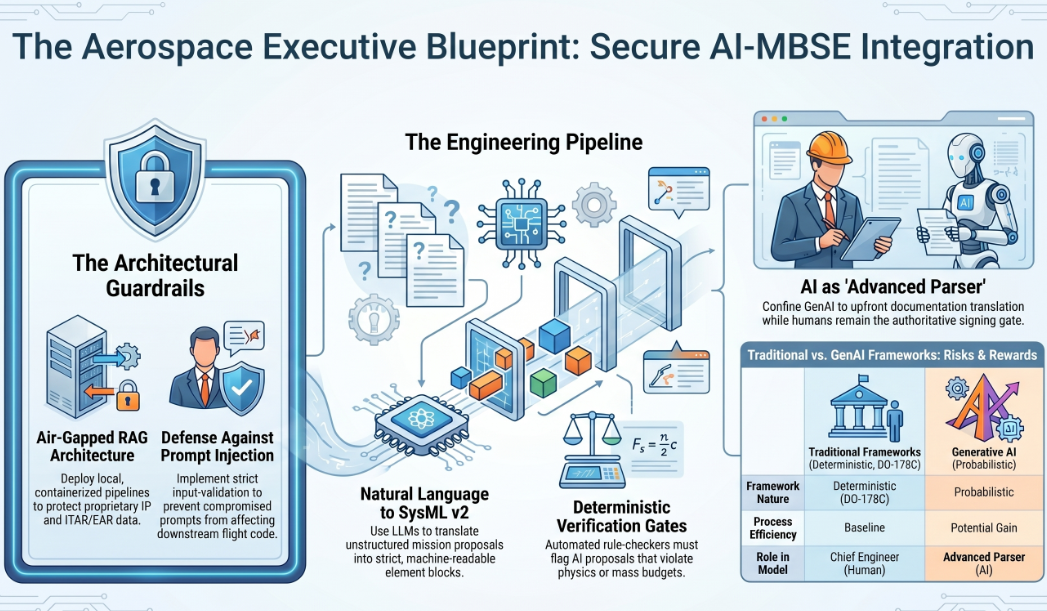

But the moment you connect a Large Language Model (LLM) to your Model-Based Systems Engineering (MBSE) environment, you open a Pandora’s box. Hallucinated requirements, shattered digital threads, and massive cybersecurity vulnerabilities can tank an audit or delay a critical program review. Traditional aerospace verification frameworks (like DO-178C or DO-254) are inherently deterministic. Generative AI is inherently probabilistic.
If you let AI act as an unguided author in your system model, your certification baseline is dead on arrival.
So, how do you capture the 30% efficiency gains of AI without sacrificing mission-critical safety and compliance?
Here is the executive blueprint for secure, deployment-ready AI-MBSE integration:
1. Establish an Air-Gapped RAG Architecture (Cybersecurity & AI)
Never let an AI query public data or train on your proprietary IP. Deploy a local, containerized Retrieval-Augmented Generation (RAG) pipeline fed strictly by your closed, verified historical program libraries. This protects your ITAR/EAR data while anchoring the AI’s “knowledge” to proven engineering baselines.
2. Map Natural Language to SysML v2 Schemas (MBSE & Systems Engineering)
Do not let the AI write free-form text requirements. Instead, use the LLM as an automated translator. Teach it to parse unstructured mission profiles or massive DoD RFPs, and output them directly into strict, machine-readable SysML v2 element blocks and interface definitions.
3. Implement Deterministic Verification Gates (Systems Safety)
AI output cannot bypass human review. Pass all AI-generated model elements through automated, deterministic rule checkers within your toolchain (e.g., Cameo/MagicDraw or Enterprise Architect plugins). If the AI’s proposal violates core physics, mass budgets, or predefined interface constraints, it must be automatically flagged and rejected before it updates the authoritative source of truth.
4. Build Defenses Against Prompt Injection (Cybersecurity)
Treat your engineering model as a high-value threat vector. If your MBSE toolchain feeds into automated downstream software generation, a compromised prompt can inject vulnerabilities directly into your flight code. Implement strict input-validation sanitization on all user-to-AI prompts.
The Strategic Takeaway for the Boardroom
AI should never be the “Chief Engineer.” It should be the “Advanced Parser.”
By confining GenAI to the tedious, upfront work of translating complex customer documentation into structured system architectures—while maintaining strict, deterministic guardrails—you protect your certification baseline while drastically cutting time-to-market.
Keep the AI in a secure sandbox, and keep the human systems engineer as the final authoritative signing gate. This is a pivotal statement in technological documentation, effectively bridging the gap between conceptual understanding and practical application. In technical writing, precision of language is paramount, and this sentence likely embodies a distilled insight or instruction that guides the reader through complex systems or processes. Its clarity, conciseness, and logical structure serve as instructional anchors, helping users navigate software or engineering workflows without ambiguity. From a documentation standpoint, such sentences are crafted to minimize cognitive load, ensuring that even novice readers can interpret the technical content correctly while maintaining the accuracy required by expert users.
Furthermore, this sentence exemplifies the role of communicative efficiency in technical materials. By providing a complete idea within a single, structured statement, it enhances readability and supports the document’s usability and accessibility standards. Its impact extends beyond mere information transfer; it also reinforces comprehension by establishing context, defining scope, or highlighting critical operational nuances. In an era where technology evolves rapidly, technical writers leverage such sentences to maintain consistency across manuals, online help systems, and troubleshooting guides, ensuring that each piece of content contributes meaningfully to a cohesive user experience.
To my fellow aerospace leaders: How is your organization balancing the massive speed of Generative AI with the rigid, non-negotiable guardrails of aerospace safety and certification? Are you piloting AI in MBSE yet, or watching from the sidelines until the standards catch up?