1. MBSE Foundations for Financial Management
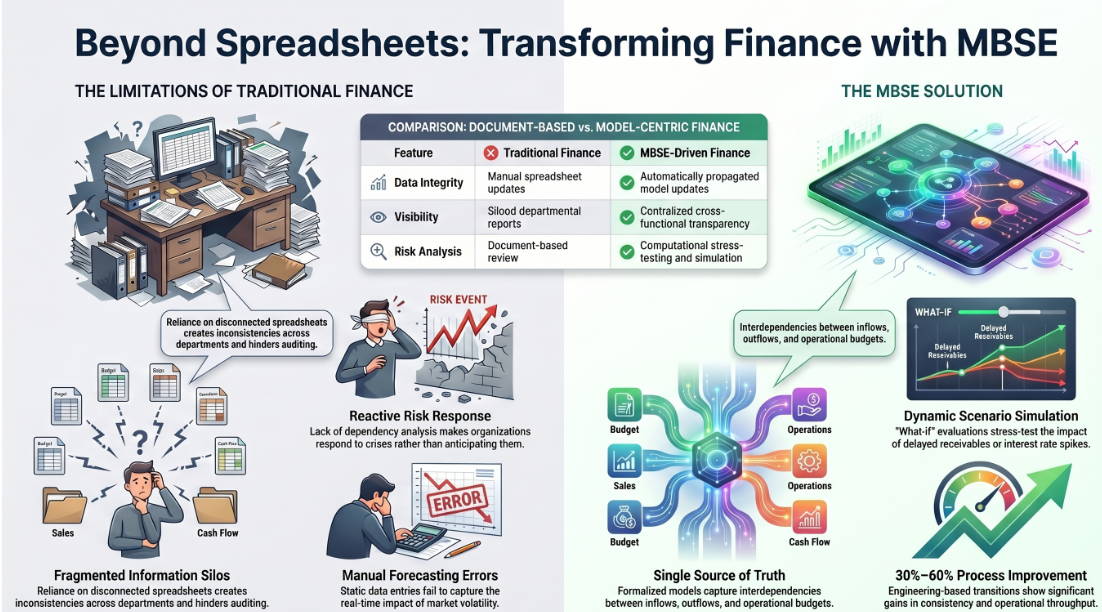
MBSE uses formalized models as central repositories of information to design, simulate, and monitor complex systems. In finance, an MBSE approach allows organizations to:
- * Visualize complex interdependencies among cash inflows, outflows, operational budgets, and investment cycles.
- * Capture business rules and system requirements in a structured manner, reducing reliance on fragmented spreadsheets or siloed reports.
- * Generate a single source of truth for financial performance metrics across departments, facilitating improved communication among finance, operations, and strategic teams.
By transitioning from traditional document- or spreadsheet-based management to a model-centric financial framework, organizations achieve consistency, easier auditing, and real-time insight into dependencies across the financial ecosystem.
2. Enhancing Cash Flow Forecasting
One of the most pressing issues in financial management is ensuring accurate cash flow forecasting. MBSE can:
- *Create dynamic models of revenue streams, payment obligations, and operational costs, allowing scenario simulations for forecast planning.
- *Detect potential liquidity bottlenecks via dependency analysis, highlighting areas where delays or variations may impact cash availability.
- *Integrate assumptions about market volatility, debt obligations, and seasonal fluctuations, enabling robust “what-if” evaluations before critical decisions.
These models become living artifacts: updates in one section (e.g., supplier payment changes) automatically propagate across all relevant components, preventing inconsistencies and errors typical in spreadsheet models.
3. Risk Assessment and Scenario Simulation
MBSE’s ability to encode rules and simulate system behavior is directly applicable to financial risk management:
- * Stress-test financial scenarios computationally, modeling effects of delayed receivables, changing interest rates, or sudden expenditure spikes.
- * Perform sensitivity and impact analysis, revealing which operational decisions affect cash flow most dramatically and where mitigation strategies are required.
- * Enable regulatory compliance checks almost automatically, linking tax, accounting, and reporting requirements with organizational models.
This predictive modeling reduces reactive decision-making, allowing finance teams to anticipate risks rather than respond to crises.
4. Integration Across Departments and Stakeholders
Financial management involves cross-functional coordination: procurement, operations, sales, and strategic offices must align. MBSE supports this through:
- * Single, cohesive models that reflect both financial and operational activities, creating transparency across teams.
- * Traceability, ensuring each financial decision is linked to supporting contracts, budgets, or forecasts, simplifying management reviews and audits.
- * Facilitating collaborative decision-making, where all stakeholders can view dependencies and outcomes of proposed initiatives in real time.
The shared visualization of dependencies fosters better alignment and reduces friction between finance, operations, and executive teams.
5. Process Optimization and Automation
Using MBSE methods, organizations can identify inefficiencies in finance and operational workflows, enabling optimized execution:
- * Model all cash-handling processes, from invoicing to payroll and capital expenditure approvals, identifying bottlenecks and redundant steps.
- * Simulate process improvements before implementation, ensuring proposed changes enhance efficiency without introducing new risks.
- * Integrate with financial management software and ERP systems, maintaining continuity and traceability of data and automating repetitive reconciliations.
As a result, MBSE not only improves the quality of insights but also reduces the effort and errors in operational financial management.
6. Quantifying ROI and Continuous Improvement
Organizations adopting MBSE can evaluate the financial benefits of modeling through:
- * Measuring reductions in forecasting errors, audit discrepancies, and process redundancies.
- * Estimating cost savings from early detection of financial risks or misalignments between departments.
- * Implementing a feedback loop, updating models continuously as actual performance data are collected, thereby improving future predictive power and operational reliability.
Industry case studies, such as aerospace and defense transitions to MBSE, have demonstrated 30–60% improvement in consistency and throughput, metrics that can be adapted to financial process gain quantification.
Conclusion
Adopting Model-Based Systems Engineering in financial management is more than a technological upgrade—it is a strategic paradigm shift from document-driven, siloed operations to integrated, model-centric decision-making. MBSE enables enterprises to visualize, simulate, and optimize cash flow, improve forecast accuracy, reduce financial risks, enhance cross-department collaboration, and continuously improve processes. By leveraging these capabilities, enterprises can achieve not only operational efficiency but stronger financial resilience, ultimately turning complex financial systems into strategic assets.
MBSE is no longer confined to engineering; its rigorous modeling methodology is a catalyst for transforming financial management, providing structured visibility and actionable insights that promote sustainable growth and operational agility.