The Ghost in the Machine
The Cycle of Recurring Frustration
In the high-stakes world of complex systems development, there is a pervasive and damaging myth: that the pressure of a deadline justifies skipping deep analysis in favor of “patchwork” solutions. Organizations frequently find themselves trapped in a loop of resolving immediate symptoms while leaving the underlying systemic diseases untreated. This leads to a phenomenon where failures are temporarily masked, only to return with greater impact later in the project lifecycle. As quality management expert Duke Okes (2009) observes: “We live in a complex world. People and organizations don’t believe they have the time to perform the in-depth analysis required to solve problems. Instead, they take remedial actions to make the problem less visible and implement a patchwork of ad hoc solutions they hope will prevent recurrence. Then when the problem returns, they get frustrated – the cycle repeats.”
The Iteration Paradox: Why Standard Project Management Models Fail Systems Engineering
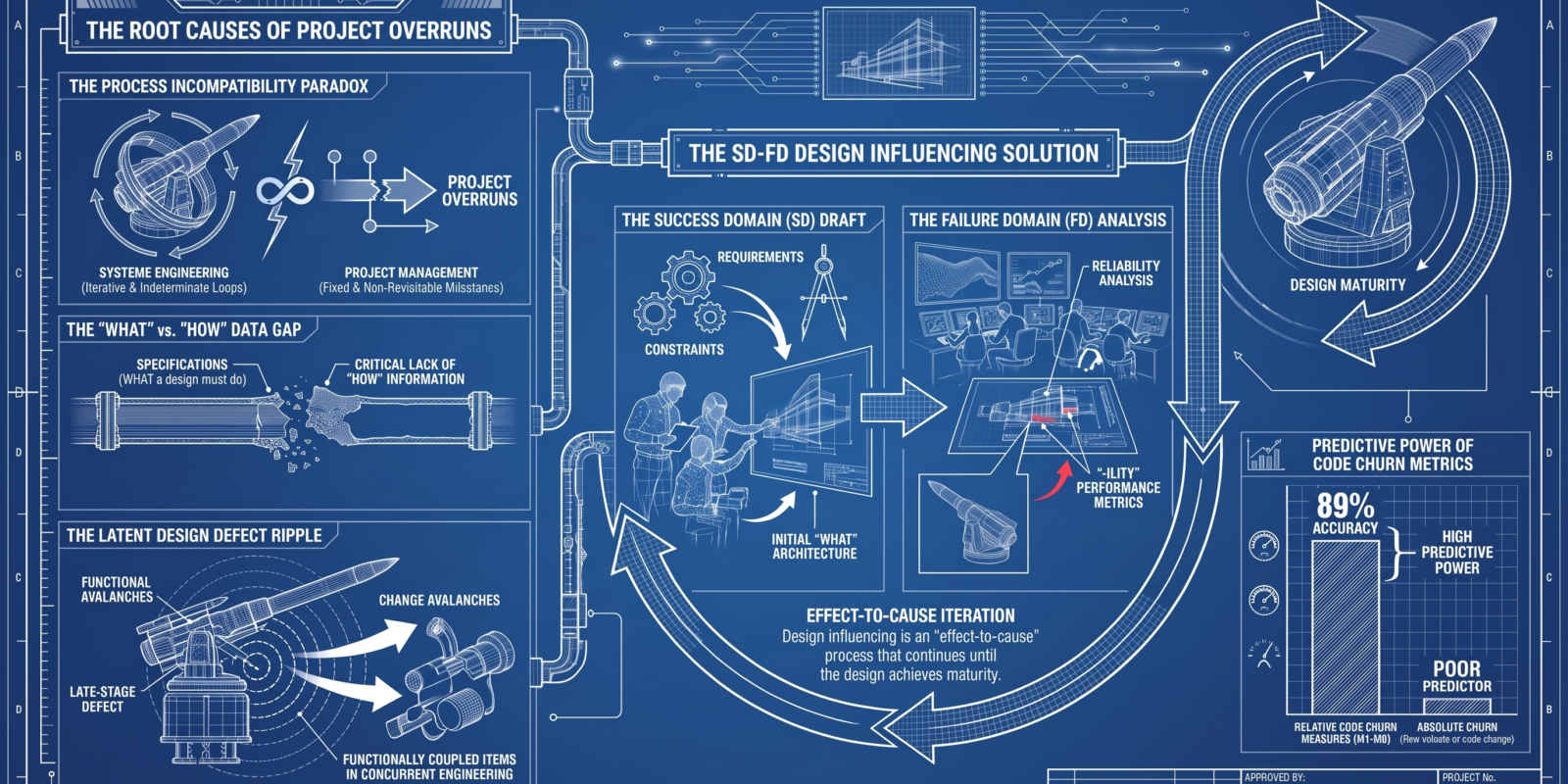
There is a structural incompatibility between the recursive nature of Systems Engineering (SE) and the linear constraints of Project Management (PM). SE is fundamentally built on iteration—a refinement loop necessary to achieve design maturity. However, major engineering handbooks (NASA, INCOSE) describe these cycles as an “indeterminate” process; they fail to state when the iteration process will no longer produce meaningful changes.Conversely, standard Project Management practices, such as those outlined in PMBOK (2008), operate on rigid “milestone” logic. Under these rules, once a milestone is marked as complete, it cannot be revisited without disrupting the baseline. This creates a paradox: while SE requires loops to ensure a design is ready, PM forbids them to protect the schedule. This incompatibility forces project managers to take unquantified risks, effectively gambling on a design’s viability to maintain the appearance of progress.
The Logic Vacuum: Documenting the “How” for Operational Resilience
Current industry standards for documentation create a massive gap in system knowledge. Systems Engineering processes are almost entirely focused on “WHAT” data. Functional specifications (governed by standards like Mil-Std-490A) detail what the design must do, and product specifications confirm the result meets those requirements. However, there is no formal requirement for designers to document the internal logic—the “HOW”—of their solutions.”This lack of ‘HOW’ data is a contributing factor for the failure of development projects of complex systems.”The long-term impact of this omission is severe. This vacuum primarily degrades the “logistics package”—the operator manuals, maintenance manuals, and training systems required for deployment. Without “HOW” data, technical authors and training specialists cannot explain how different system components interact. More critically, during the operational life cycle, future teams are forced to “reverse engineer” the logic to implement upgrades, leading to unexpected failures and expensive re-qualification testing that could have been avoided.
The Change Avalanche: Quantifying the Hidden Risk of Functional Couplings
In a concurrent engineering environment, system elements are rarely independent. They are “functionally coupled,” meaning a change in one component ripples through the hierarchy. This is often described as a “change avalanche.” These avalanches are typically triggered by a “Class I” change—a modification that affects the form, fit, or function (FFF) of a component.Consider the “bathroom faucet” example: To control temperature and flow rate, one must adjust two handles. It is impossible to adjust one without affecting the other. In engineering, these dependencies are governed by specific coupling rules:
- Cs = 1: There is a functional coupling between the affected items.
- Cs = 0: There is no functional coupling between the items.
- The Emergent Properties Rule: Due to emergent properties, $C_s$ is always 1 between a component and its parent/child hierarchy.The mathematical reality of these couplings is stark. Analysis of a simple three-level system hierarchy shows that even minimum functional couplings can result in a 213% increase in cost and a 300% penalty to the schedule .
The Baseline Myth: A Counter-Intuitive Analysis of Budget Killers
It is a common belief that cost overruns are primarily caused by “baseline instability”—the frequent changes to a contract after it has been awarded, often referred to as a “rubber baseline.” However, empirical research challenges this assumption.Counter-Intuitive Finding: A study by Christensen et al. (1998) of over 400 defense projects reached the surprising conclusion that there is no relationship between baseline instability and cost overruns. This suggests that the true root causes of failure are not external contractual shifts, but rather internal systemic issues—specifically, the failure to manage the “how” of the design and the inherent conflicts between SE and PM processes.
The Matrix Trap: Premature Release and the Stage Gate Illusion
The “Stage Gate” model is intended to ensure that a project does not move to the next phase until its objectives are met. However, under severe schedule pressure, this model often becomes a gamble. Project managers may release an “unacceptable” or immature design to the next level of integration just to hit a milestone.This does not solve the defect; it merely shifts it to a stage where corrective resources are significantly more expensive. Furthermore, under a matrix organizational management structure (Blanchard, 1998) , the original design resources are often reassigned to other projects once the gate is crossed. This leaves the integration team with a flawed design and no one to fix it, leading to further unplanned delays.The only effective mitigation is “effect-to-cause” design influencing—performing deep analysis, such as Fault Tree Analysis (FTA), as early as possible to ensure Design Maturity . According to Healy (1989), a system only reaches maturity when it “performs its required function at specified performance levels at an optimum Life Cycle Cost for a stated period of time.”
Beyond Remedial Actions
Solving the “Ghost in the Machine” requires moving beyond remedial, symptomatic fixes and adopting a true systems view accompanied by “proper design management.” Success depends on prioritizing the “how” and the “why” of a system before committing to the “what.”As we look at the recurring failures in complex projects, we must ask: Are our foundational project management tools—like the PERT or Precedence Diagramming Method (PDM)—actually equipped to handle the iterative, non-linear reality of modern systems engineering? Current evidence suggests they are not, and until we bridge the gap between iterative design and rigid management, the cycle of frustration will continue.
By
Chandler Archuleta, MBA, CISSP, CEH, PSM